Winter Swans
'Winter Swans' by Owen Sheers is a deeply moving exploration of a relationship in crisis finding unexpected reconciliation. Studying this poem offers a brilliant opportunity to secure top marks by analysing how a poet uses natural imagery and subtle structural shifts to mirror complex human emotions.
Study Notes
Overview
'Winter Swans' by Owen Sheers explores the emotional distance between two lovers, using the natural imagery of swans after a storm as a metaphor for reconciliation and enduring partnership. The poem examines how vulnerability and shared silence can lead to healing, reflecting typical GCSE themes of love's complexities and the power of nature to mirror human relationships. Examiners look for candidates who can confidently connect the poem's natural imagery to the couple's emotional state, rather than just describing the landscape. You must demonstrate an understanding of how the poem's structure—moving from fragmented tercets to a unified final couplet—reflects the journey from separation to reconciliation.
Listen to the Podcast
Plot/Content Overview
The poem follows a couple walking around a lake after two days of heavy rain. The atmosphere is tense and silent, reflecting an emotional distance or recent conflict between them. The landscape is 'waterlogged', mirroring their saturated emotional state. As they walk, they notice a pair of swans on the water. The swans dive beneath the surface and return, acting as a symbol of resilience. This shared observation becomes a turning point; the tension breaks, and by the end of the poem, the couple's hands find each other, their physical connection compared to a pair of wings settling after flight.
Themes
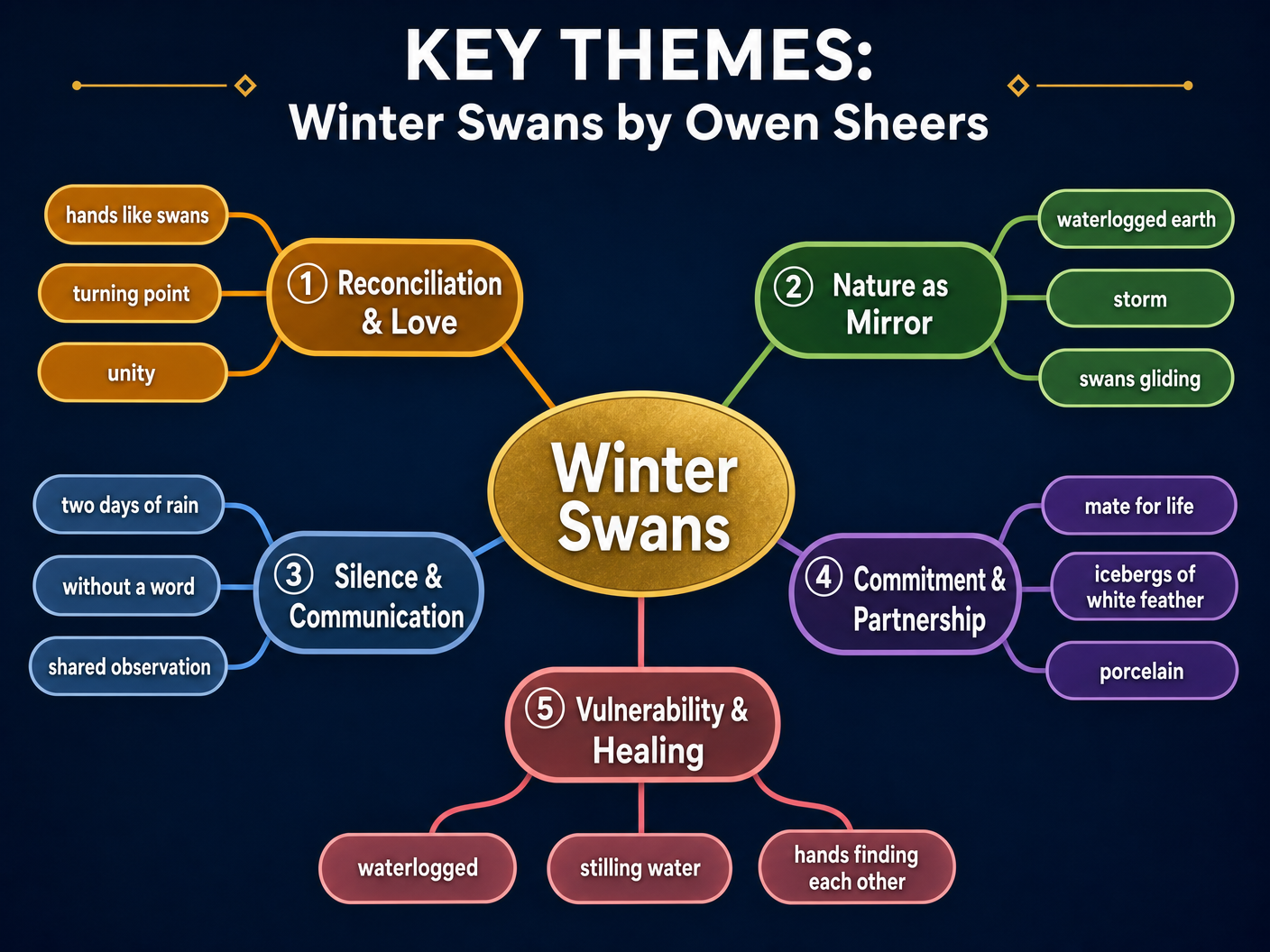
Theme 1: Reconciliation & Love
Reconciliation is the driving force of the poem. The narrative arc moves definitively from conflict and emotional distance to a renewed connection. Sheers presents love not as an easy, constant state, but as something that requires weathering storms and finding moments of shared understanding to heal.
Key Quotes:
- "our hands, that had, somehow, / swum the distance between us" (Stanza 6) - The personification of hands 'swimming' the distance highlights that reconciliation requires effort, but also feels natural and inevitable.
- "like a pair of wings settling after flight." (Final Couplet) - The simile comparing their hands to wings provides a profound sense of peace and unity, concluding the poem on a hopeful note.
Theme 2: Nature as Mirror (Pathetic Fallacy)
Sheers uses the natural environment to reflect the internal emotional landscape of the couple. The turbulent weather mirrors their conflict, while the calmness of the swans mirrors their eventual peace.
Key Quotes:
- "The clouds had given their all - / two days of rain and then a break" (Stanza 1) - The storm represents their argument; the 'break' in the weather signifies the pause in their conflict, a moment of exhaustion where healing can begin.
- "waterlogged earth / gulping for breath at our feet" (Stanza 1) - The personification of the earth 'gulping for breath' reflects the suffocating, overwhelming nature of their dispute.
Theme 3: Silence and Communication
The poem highlights how communication in a relationship isn't always verbal. Initially, silence is a barrier, but it transforms into a shared, comfortable space.
Key Quotes:
- "we skirted the lake, silent and apart," (Stanza 2) - The physical action of 'skirting' the lake mirrors how they are avoiding the core issues in their relationship. The silence here is heavy and divisive.
- "'They mate for life' you said as they left," (Stanza 5) - This is the only direct speech in the poem. It functions as an indirect declaration of commitment, breaking the tense silence with a statement of enduring love.
Writer's Methods
Form and Structure
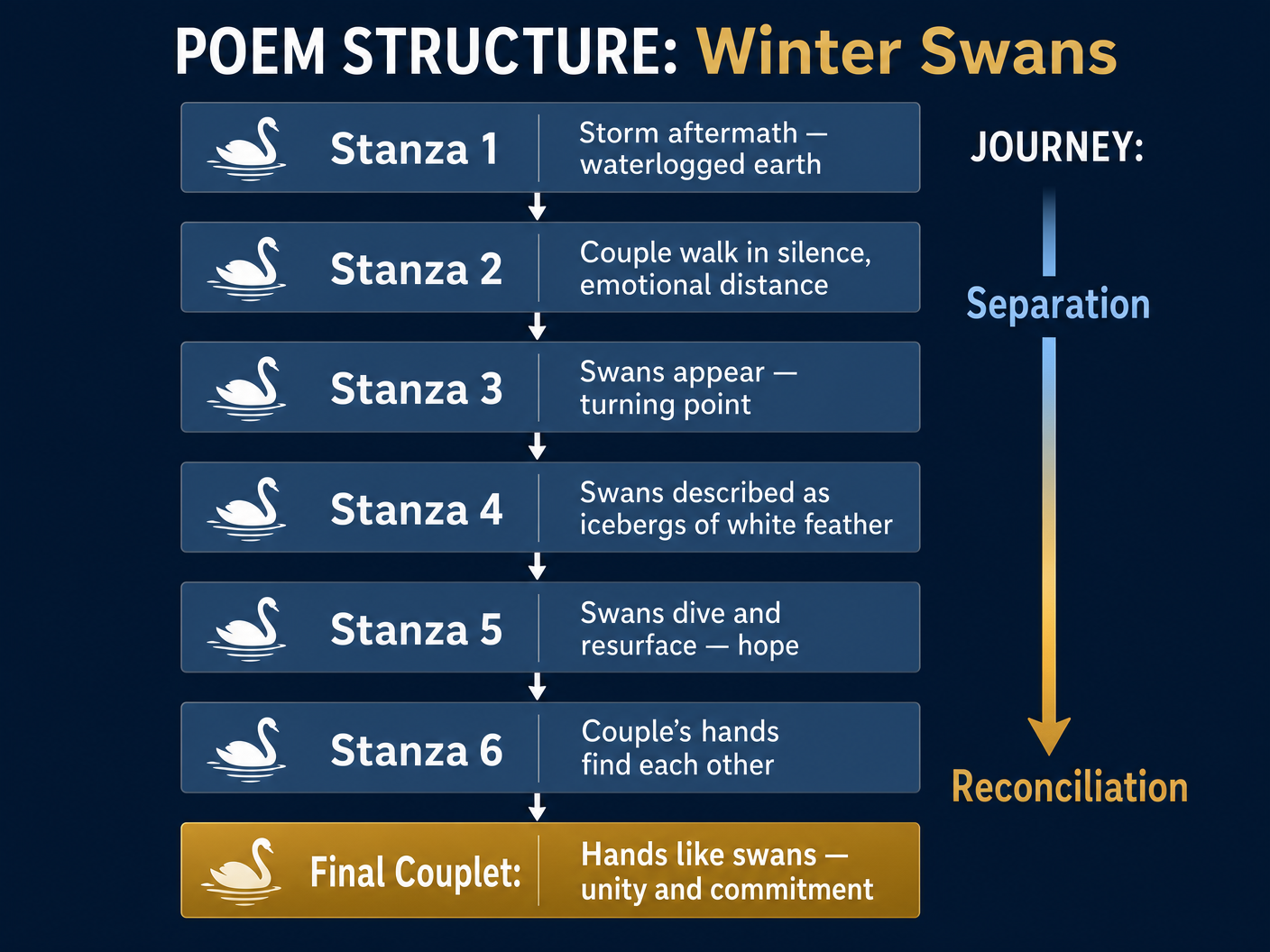
Sheers employs a highly deliberate structure to mirror the poem's thematic journey. The poem is composed of six tercets (three-line stanzas) followed by a final couplet. The tercets are irregular, lacking a consistent rhyme scheme, which reflects the disjointed, unpredictable nature of the couple's relationship at the start.
The heavy use of enjambment (where lines flow into the next without punctuation) creates a sense of ongoing movement and unresolved tension. The turning point occurs when the swans appear, but the true structural resolution arrives in the final couplet. The shift from three-line stanzas to a two-line stanza visually and rhythmically enacts the couple coming together—two separate entities forming a unified pair.
Language and Imagery
The central metaphor of the swans is layered and complex. Sheers describes them as "icebergs of white feather". This metaphor is crucial: an iceberg has most of its mass hidden beneath the surface. This suggests that both the swans and the couple's relationship have hidden depths; what is visible on the surface does not represent the entirety of their bond.
The description of the water as "stilling" (a present participle) rather than "still" indicates an active, ongoing process of calming down, perfectly capturing the delicate transition from conflict to peace.
Context
Owen Sheers is a contemporary Welsh poet. 'Winter Swans' was published in his 2005 collection Skirrid Hill. The word 'Skirrid' derives from the Welsh word 'ysgyrid', meaning divorced or separated. This contextual detail is highly relevant, as the collection frequently explores themes of separation, division, and the landscapes of relationships. Understanding this helps illuminate why the poem begins in a state of emotional fracture before moving towards unity. Examiners reward candidates who use this context to deepen their analysis of the poem's starting point of 'separation'.
Worked Examples
2 detailed examples with solutions and examiner commentary
Practice Questions
Test your understanding — click to reveal model answers
Compare how poets present the difficulties of relationships in 'Winter Swans' and one other poem from your anthology.
Hint: Consider 'Neutral Tones' for a contrast in resolution, or 'The Farmer's Bride' for a contrast in how nature is used.
Explore how Sheers uses language to convey a sense of hope in 'Winter Swans'.
Hint: Look closely at the transition in language from the beginning of the poem to the end. Focus on verbs and metaphors.